A Cry from
Uganda
An interview with Richard Sempala,
Director
Africa Life Youth Foundation
By Dennis Howard, President
The
Movement for a Better America
Here is the
complete interview:
Howard: Tell me more about your background, Richard.
What was it like for you growing up in Uganda, and what led you to your present
work?
Sempala:
It's a blessing to talk with you, brother. You are always so encouraging. I
think God has brought us together for a higher purpose. Our worlds are so
different, but so many problems are the same -- just worse here because we are
so poor.
I don't have any real memory of my
early childhood. I believe my mother was a prostitute, and I was simply
abandoned on the street at an early age. My first memories are as a street
child begging for whatever scraps of food or clothes I needed to survive.
However, I am grateful that I was
thrown out in the street instead of being aborted. At least I am alive to tell
about it. Later, I remember coming home and finding nothing to eat and then
having to go to school still hungry the next day. But God is good, and I was
taken in by Christian missionaries, and became the foster child of very loving
people.
I owe my life and faith to them, and to
Our Lord who saved me. It is a miracle that I am alive. I was born again, and as I grew older, I
wanted to give back the kindness that was given to me. That led me to working
with young people who needed help the way I once did.
Howard: So what kind of
problems do they face?
Sempala: It
depends on their age, but most of the people I work with are of high school and
college age, and the problems are many: economic hardship, premarital sex,
school drop-outs, shame and family strife, and for the boys, being thrown into
jail. In Uganda, if a boy gets a girl under 18 pregnant, the parents can have
him thrown into jail, and by law the boy has to spend 14 years in jail.
Premarital sex also results in unwanted pregnancies. Most of the girls are
ashamed to be pregnant while they are still in school, so they end up having an
abortion, which is a tragedy for both mother and the unborn baby.
Howard: How do you deal with that?
Sempala: Our approach is mainly educational. We
try to help young people develop the right attitudes to avoid unwanted
pregnancy and abortion. We place a strong emphasis on abstinence before
marriage as the best prevention. We believe that if young people get to
understand all the dangers, it will reduce the abortion rate and help solve the
problem of poverty in Africa.
A
major part of our approach is motivating young people to concentrate on their
education and work for a brighter future. Nothing has done more harm to
education in this century than the early sexualization of children. The fastest
period of intellectual growth is
between 5 and 13. Sexualizing children that young is a disaster for them
and for the future of our country.
Abortion is
also believed to be a leading cause of maternal death in the country. A
1992-1993 study in three Kampala hospitals found that 21% of maternal deaths
were due to abortion-related complications like hemorrhage, sepsis (infection),
uterine perforation and cervical injury, which can turn into longer
consequences like infertility
Abortion not only threatens
the lives and health of Ugandan women but also drains limited resources from
the country�s health care system. Women who have abortion complications may
require extended hospitalization, treatment with expensive antibiotics, or
blood transfusions, which 95% of Ugandan women can�t afford. The result can be
death.
Howard: What are the
major reasons they abort?
Sempala: Women in Uganda
express many reasons for seeking to end a pregnancy: being unmarried, having
conceived at the wrong time, having too many children, living in poverty, being
in poor health, or having become pregnant as a result of rape or incest.
At
the national level, however, we do not have a totally clear picture of how many
young people obtain abortions, since many women in Uganda use local herbs to
induce abortion. Often, they have no
access to hospital or health care clinics. Still others accept traditional
culture to offer parts of born children to appease evil spirits. It's tragic,
but it happens.
Howard: How big a problem
are STD's and AIDS? What do you tell younger kids about them? And what do you
say to older young adults?
Sempala: Young people are at the center of the
global AIDS epidemic. About 40 per cent
of new HIV infections involve young people. This group also has the highest
rates of sexually transmitted infections other than HIV. Young people are
particularly vulnerable to HIV infection --
3.2 million young people who live in Sub-Saharan Africa are believed to
be infected with the virus. Young women between 15 and 24 are more likely than
young men to be HIV positive.
Howard: It
seems that we have a world-wide problem because of the early sexualization of
children, as well as treating them as "objects" that can be easily
discarded, whether it is by abortion or simply abandoning them to the street.
What are you telling young people to prevent this from happening to still
another generation?
Sempala:
We try to reach them as early as
posssible. Premarital sex is a problem in high school, and then increases as
young people move on to university or young adulthood. We try to show them the
negative consequences of premarital sex and encourage them to abstain before
marriage. We also use movies that show the experience of others. That has done
a lot to touch their hearts on the wisdom of abstaining.
Howard: What are some
the problems they run into?
Sempala:
Premarital sex often leads to promiscuity. Sex becomes a way for them to prove themselves. They start
wanting to sleep with different boys and become unable to establish lifetime
bonding. The same thing happens to boys. The result is they have difficulty
establishing and sustaining a later marriage.
Premarital sex also hurts
young people mentally and spiritually. They lose interest in school and the
result is poor performance, and then they drop out. They often lose contact with God, and end up dropping out of
church as well because of the shame.
In some cases, young women feel used,
and end up hating men and never being able to trust a man. I have counseled
university women who met men who convinced them they wanted to marry them, but
after having sex many times, the guys decided to drop them. That caused
bitterness and disappointment. Now they hate men seriously.
Howard: That sounds
similar to the situation here in the U.S.
Are there there any problems peculiar to Africa or Uganda?
Sempala:
Uganda is predominantly Christian --
40% Catholic and 40% Protestant with a smaller Muslim minority. But we also have a mixture of pagan,
Christian and Muslim cultures that has a long history. Some pagan practices
still survive. Currently we have a big problem in Uganda with child sacrifice.
Premarital sex has contributed to this evil in unexpected ways. If a girl
becomes pregnant, and the boy denies the pregnancy, the girl suffers alone. So
she faces the problem of how to take care of the baby and herself.
Some end up selling their babies to
pagan businessmen who use them as sacrifices to evil spirits so their
businesses will prosper. Some women
sell their babies because they don't think anyone else will marry them if they
have a child. The unintended consequences of premarital sex can take many
forms.
Howard: What about the
consequences of STD's, HIV, and AIDS?
Sempala:
When young people discover that they are infected, they often lose interest in
education and end up joining the wrong groups. Some take it out on others
because of bitterness by infecting as many others as they can. Or they end up
losing friends their own age or dying themselves. HIV/AIDS has also increased
the number of suicides among young people. When they find that are infected,
they think they have lost the love and trust of their families and end up
killing themselves.
Howard: How do you try to
help these people?
Sempala:
Young people's needs are not limited to prevention alone. Those who are HIV
positive need care, treatment and support as well as spiritual guidance. Some
don't even know they are infected. Unfortunately, some religious leaders don't
deal very well with HIV/AIDS and STD victims, although a lot of church members
are infected and living with the virus. Talking about holy and spiritual things
doesn't always work. You have deal with their very human problems, too.
I guess that's why our approach works.
Because I grew up on the street, and saw so many of these problems firsthand
before being born again, I am able to share my experience, strength and hope
when others cannot.
Howard: So how do you talk
to older kids who have already gotten involved in sex?
Sempala: We
try to connect them with other people who have gone through the same thing, and
give them the hope to be found in Scripture. This helps many people turn their
lives around, and stay safe until they meet the right person for marriage.
We also try to
help them on a material level. Many of them lack jobs so we help them create
jobs to earn money to sustain their needs and be able to support families. We
also have an agriculture project that helps them survive and go on with their
lives. They plant greens and other cash crops on a small scale, and raise pigs
and poultry, and at the same time, they learn agricultural skills.
Basically, these people
need five things. They need factual information to guide them. Plus the skills
to deal with their situations. We also provide them with youth-friendly health
services that enable them to get help without being shamed. Finally, they need
a safe environment where they can get the spiritual and emotional support they
need to change.
Howard: Do have any special approaches that help them find that?
Sempala: We use youth-adult partnerships and other
programs that are new ways of involving young people in HIV prevention. They
are based on the understanding that young people have a right to participate in
programs that affect them, plus the programs are more effective when youth are
treated as partners. Because they are often less knowledgeable than their adult
partners, these partnerships can focus on technical assistance and training
that empowers young people to make their voices heard.
We
find that young people can become important advocates for their needs. Policies
also become more sensitive to their perspectives. We encourage young people to
engage in outreach activities using one-to-one communications, and through
groups such as clubs, sports teams, schools and youth gatherings. They learn to
use music, dance and drama to speak about STD and HIV/AIDS.
Howard: What do you say to
parents?
Sempala: Whenever I have chance to speak to parents I
always tell them to become friends to their children, and not just authority
figures. As children reach young adulthood, parents have to see themselves as
their children's most important mentors. They have to teach more by example
than by lecturing. Many parents experience a communications gap with their
children and never find out what their children are experiencing emotionally.
Another problem unique to Africa are people with large numbers of children
because of polygamy. A man with 40
children can't pay much attention to any of them.
Howard:
Do you receive
government funding for your work and, if so, does that limit you?
Sempala: We
don't receive any government funds, so we have complete freedom to speak out
against abortion and unwanted pregnancy. Our funding comes from voluntary
donations, and that of course means that we are completely dependent on God's
providence. We also get help from supportive ministries like Movement for a
Better America, the Life Aid Foundation and Freedom's Hope Ministries
(http://www.fhm.spruz.net). Mike and Londa Furman of FHM have been helping us
actively for at least five years. We could not exist without such help.
Howard: So what are your
most active programs right now?
Sempala:
They fall into five main areas:
1. Pro-Life
Uganda,
which is our main pro-life outreach to high school and university students.
Abortion has done major damage to their value system, dispirited our young
people, and left millions with guilt and shame that can last a lifetime. We
need help for our Recovery Center, where young people come to us for counseling
and financial help. We also need funding for Christian training materials on
the life issues.
2. Mobile Health Clinics.
Many people can't afford to go to hospital or clinics for health care, or help
with pregnancies. Currently, we're giving out mosquito netting to help fight
malaria, one of our greatest scourges.
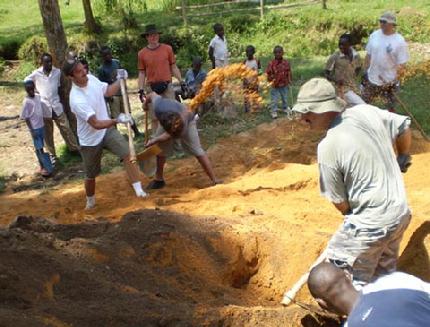
3. Gospel Youth Camps for outreach and to help renovate people's
houses. We have a Youth Week that helps young people socialize in a Christian
setting and become more aware of balancing their physical and spiritual needs.
4. An Agricultural Project to help develop agricultural and other skills, including
planting green vegetables, raising pigs and poultry, and starting small
businesses. These help teach the basics for income generation and economic
survival.
5. A Water Project
that includes drilling wells and training people to use resources wisely. Water
is very critical one here.
Howard: You recently
finished a youth conference and an outreach to a Sudanese refugee camp in
Uganda. Tell me more about these.
Sempala:
Our Youth Conference took place in Western Uganda. It was for 3 days and 250
young people attended. Over 1,000 registered, but we couldn't accommodate them
because we didn't have the funds to feed them. The main focus was on preventing
abortion and unwanted pregnancy. I also spoke on how young Christians should
walk in a sinful world. Food and transportation alone cost cost $1700, but we
had to borrow much of that to meet our commitment. The need is great, and the
eagerness of these young people to hear the truth is amazing. We need help to
respond to both.
Our visit to the Sudanese refugee camp
was a 1-day event, but their need is awesome. They have been victims of a cruel
civil war for 21 years. Young Sudanese know nothing but a world full of war and
the killing of innocent people, so they desperately need God's love and mercy,
as well as His justice.
Howard: That
sounds like a challenge for the whole Christian community.
Sempala:
This is a time for unity and solidarity among pro-life people of good will
throughout the world. We are grateful for the helping hands of our friends in
America. The world seems to be in a satanic grip targeting the young people of
this world as victims, both moral and spiritual -- seeking to turn them away
from the living God -- and material and emotional as well. We have all become
one, both in Africa and America, and the time is at hand for us to respond to
the cries of our youngest generation.
Donations for Richard
Sempala's work can be sent to:
Movement for a
Better America
PO Box 472, Mt. Freedom, NJ 07970
Write
"Uganda Project" on the memo line of your check.
For more info, email: [email protected]
Visit the Africa Life Youth Foundation
|